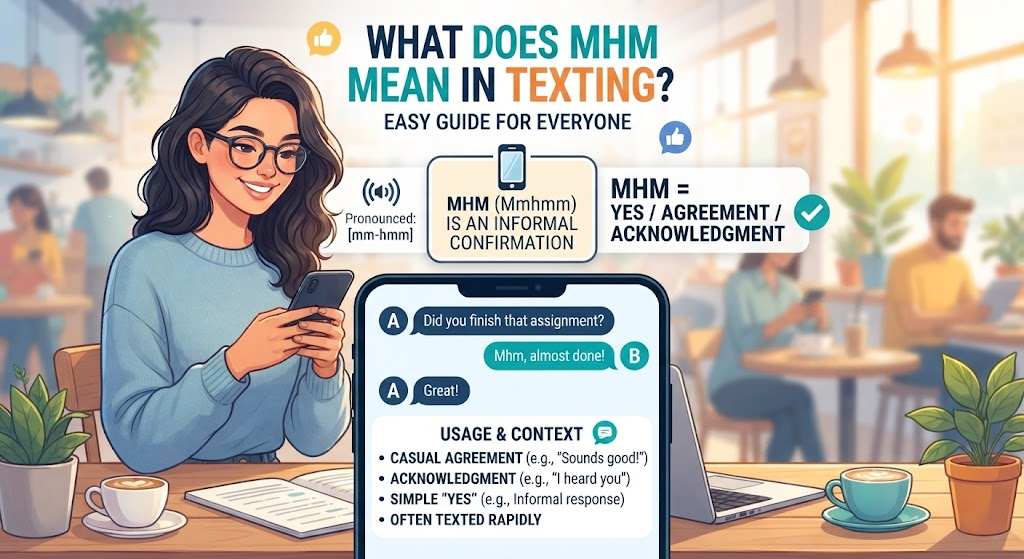
Have you ever sent a detailed text message to a friend and received a short reply that just said “mhm“? You might pause and wonder what that simple combination of letters actually means. Understanding modern online slang can feel confusing because people use short words every day on texting apps, social media, and online chats.
In simple terms, “mhm” is a casual way to say “yes,” “yeah,” or “I agree.” It sounds just like the hum you make when nodding your head to agree with someone in person. However, depending on the conversation, this short response can mean different things like “sure,” “I hear you,” or even a cold “whatever.”
In this complete guide, you will learn the exact meaning of this popular text term, its origin, how tone changes its feeling, and how you should reply whenever someone sends it to you.
Table of Contents
What Does Mhm Mean in Daily Text Messages?
When people ask what does mhm mean, the most direct answer is that it serves as an informal substitute for the word “yes.” It mimics a natural sound human beings make during spoken conversations. When you agree with a statement without wanting to interrupt, you make a gentle humming sound with your mouth closed. Texting this word transfers that exact real-life sound into written chat.
People use it to keep conversations fast and effortless on mobile devices. Typing three simple letters takes less time than writing full phrases like “Yes, I completely agree with you.” It lets the sender acknowledge your point while keeping the dialogue moving smoothly along.
The Natural Origin of the Sound
Before it became a common text term, this sound was used in spoken language for many generations. Linguists classify it as an interjection—a word or sound used to express a quick emotion or reaction. It exists in many languages worldwide because making a two-syllable sound with closed lips requires very little physical effort.
With the rise of mobile phones, instant messaging, and social media platforms, spoken sounds quickly turned into written words. Today, typing these three letters is universally understood across millions of chat threads every single day.
Different Meanings Based on Context and Tone
Even though the base meaning is “yes,” the real emotion behind the message changes depending on context. The relationship between the senders and the topic being discussed plays a massive role in how the message feels.
- Agreement: Saying “yes” to a question or statement.
- Active Listening: Showing someone that you are reading their long story.
- Casual Confirmation: Giving a quick “sure” to a simple request.
- Slight Disinterest: Indicating that you heard the message, but do not want to discuss it further.
Understanding these subtle differences helps you read between the lines during digital conversations.
Friendly Agreement and Simple Affirmation
In most everyday texting scenarios, this response is completely friendly and relaxed. It shows that the other person is fully engaged and agrees with what you just shared with them.
For instance, if you ask a close friend if they want to grab lunch, receiving this term means they are happy to join you. It gives a casual, low-pressure green light to your plans without needing formal words.
Detailed Overview Table
| Details | Information |
| Primary Term | Mhm |
| Type of Term | Text slang, interjection, informal acronym |
| Primary Meaning | Yes, I agree, sure, or okay |
| Secondary Meanings | You’re welcome, I am listening, or a cold acknowledgment |
| Pronunciation | “Mm-hmm” (a two-syllable humming sound) |
| Tone Variations | Friendly, neutral, bored, passive-aggressive, or sarcastic |
| Common Platforms | iMessage, WhatsApp, Snapchat, TikTok, Instagram |
| Best Used With | Close friends, casual contacts, family, and peers |
| Avoid Using In | Professional emails, formal business letters, job applications |
Using it as “You’re Welcome”
Another very common way people use this word is as an informal response to “thank you.” Instead of typing “you are very welcome,” younger generations often reply with a quick hum in text form.
In this context, it carries the same relaxed meaning as saying “no problem,” “anytime,” or “don’t worry about it.” It tells the recipient that helping them out was easy and no trouble at all.
Spotting Passive-Aggressive or Cold Tone
Because text messages lack face-to-face vocal inflection and body language, short words can sometimes feel cold or blunt. If someone gives you a single-word response during a serious discussion, it might signal annoyance or impatience.
A short reply without any emojis or punctuation can mean “I heard you, but I am done talking.” If you suspect a cold tone, look at the recent messages to see if the mood shifted suddenly.
Mhm vs. Other Common Text Slang
It helps to compare this word with other popular text terms so you know when to use each option correctly in your chats.
- Mhm vs. Yeah: “Yeah” is slightly more formal than humming, but both express quick agreement.
- Mhm vs. K / Okay: “Okay” confirms a fact or direction, while humming usually signals agreement or acknowledgment.
- Mhm vs. Mm: “Mm” shows deep thought, taste satisfaction, or hesitation, whereas adding the second syllable confirms a “yes.”
Choosing the right slang word helps you set the exact emotional tone you want.
Clear Examples of How to Use it in Chats
Here are real-life texting examples showing how this word functions across different situations:
Example 1: Quick Agreement
- Person A: “Are we still meeting at 5 PM today?”
- Person B: “Mhm, see you soon!”
Example 2: Saying You’re Welcome
- Person A: “Thanks for grabbing my mail while I was away!”
- Person B: “Mhm! Glad I could help.”
Example 3: Active Listening
- Person A: “So then the mechanic told me the repair would take three extra days…”
- Person B: “Mhm, that is so frustrating.”
Best Ways to Reply When Someone Sends It to You
Knowing how to respond depends Mhm entirely on the tone of the conversation. If the mood is casual and happy, you can keep the chat going by sharing your next thought or dropping a fun emoji.
If the message feels blunt or short, you can wrap up the chat gracefully or ask a direct question to clarify their feelings. Matching their energy keeps digital communication smooth and stress-free.

When You Should Avoid Using This Term
While great for informal texts, you should avoid using this word in professional settings. Sending short slang to a boss, client, or teacher can come across as unprofessional, lazy, or disrespectful.
For work emails, job interviews, or formal messages, stick to clear words like “Yes,” “Certainly,” “Absolutely,” or “I agree.” Reserve slang for friends, family, and casual group chats.
Final Thoughts
Now you never have to wonder what does mhm mean when it pops up on your screen. It is a quick, natural, and versatile way to express agreement, confirm plans, or say “you’re welcome” in modern digital conversations. By paying attention to the context and your relationship with the sender, you can easily read the true meaning behind those three simple letters.
Frequently Asked Questions (FAQs)
What does mhm mean from a girl or a boy in texting?
It generally means “yes” or “I agree” regardless of gender. However, if accompanied by warm emojis, it signals friendly interest, while a standalone reply might mean a casual or neutral tone.
Is using this word considered rude?
It is not inherently rude, but it can feel dismissive if used during serious conversations. Using it in professional or formal environments can be seen as impolite or overly casual.
How do you pronounce this word correctly?
It is pronounced as a two-syllable humming sound, “Mm-hmm,” with the emphasis typically placed on the second syllable while keeping your lips closed.
Can it mean “no” in any situation?
No, it almost always means “yes” or “okay.” If someone wants to say “no,” they will usually type “uh-uh” or “nn-nn” instead.
Why do people type this instead of typing “yes”?
It feels more conversational, relaxed, and fast to type. It recreates natural speech habits in digital chat forms.
What is the difference between “mhm” and “hmm”?
“Mhm” means “yes” or agreement, while “hmm” expresses thinking, uncertainty, doubt, or hesitation about a topic.

